

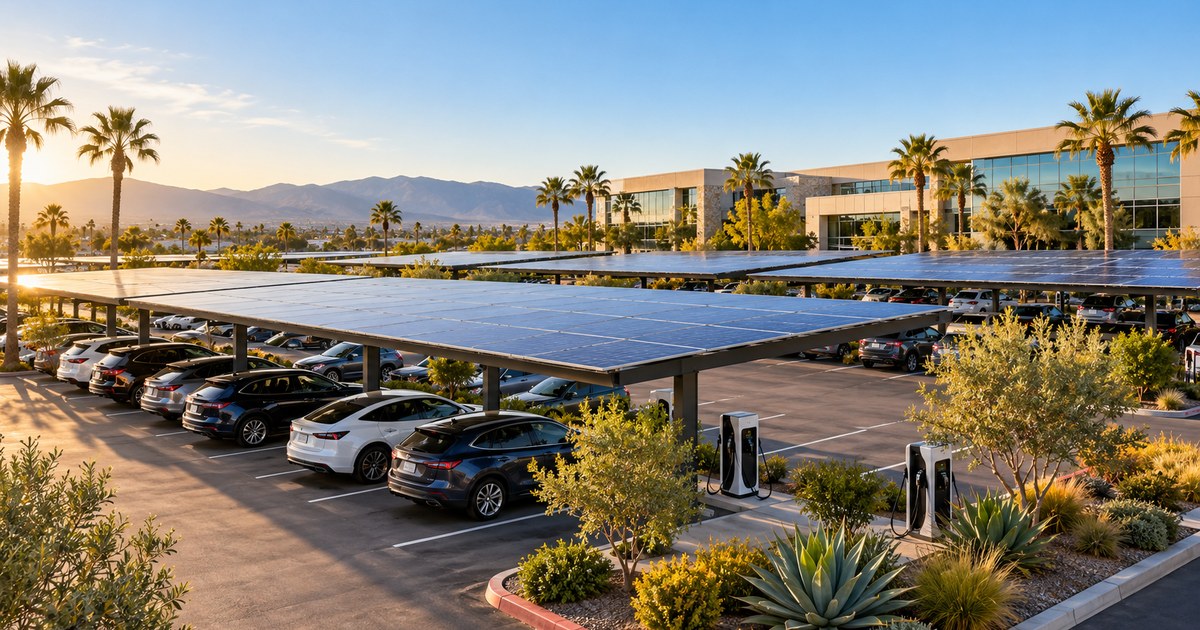
Commercial real estate owners across California face a distinct set of operational challenges in today’s economic climate. Between escalating utility rate structures, stringent state clean energy mandates, and shifting tenant expectations, property managers must continuously uncover new avenues for capital efficiency. One of the most effective yet frequently overlooked assets in commercial portfolios sits right outside the building: the surface parking lot. By converting vast asphalt lots into active energy-generating assets, forward-thinking landlords are unlocking substantial financial and operational value.
Transforming Underutilized Parking Lots into Revenue Drivers
Traditional surface parking represents a passive operational cost. Asphalt requires recurring maintenance, repaving, and lighting expenses without generating direct revenue. Installing overhead solar canopy systems turns these expansive surfaces into high-yield clean energy generators without taking away valuable parking stalls or requiring additional land acquisition.
Through the integration of modern commercial solar carports, property owners can generate on-site renewable power directly where it is consumed. This localized energy production substantially offsets facility electricity consumption, dramatically cuts peak utility demand charges, and provides long-term insulation against predictable annual utility rate hikes across California's major power providers.
Mitigating California Peak Demand Charges and Utility Volatility
For commercial facilities—including office parks, retail centers, logistics warehouses, and healthcare campuses—demand charges often represent between 30% and 50% of the monthly electric utility bill. These charges are calculated based on the highest 15-minute window of electricity consumption during peak operational hours.
Solar carports generate peak power precisely during the brightest parts of the day, which frequently aligns with mid-day and early afternoon commercial peak demand spikes. By shaving these expensive peak loads through on-site solar generation, building operators can achieve immediate and sustained reductions in monthly operating expenditures (OpEx). Furthermore, power purchase agreements (PPAs), accelerated depreciation under the Modified Accelerated Cost Recovery System (MACRS), and federal Investment Tax Credits (ITC) significantly enhance upfront project economics and shorten payback periods.
Delivering High-Value Amenities for Tenants and Customers
Beyond immediate energy savings, solar canopies provide tangible tenant amenities that drive leasing retention and premium lease rates. In regions where summer temperatures routinely exceed 90 degrees Fahrenheit, shaded parking is an attractive perk for corporate employees, customers, and retail visitors. Shaded vehicles remain noticeably cooler, reducing initial air conditioning load and enhancing overall visitor satisfaction.
Additionally, solar canopy structures serve as the ideal physical mounting framework for Level 2 and DC Fast electric vehicle (EV) charging stations. As California continues to lead the nation in electric vehicle adoption, offering dedicated on-site EV charging has transitioned from a niche luxury into an essential building amenity. Integrating solar power with EV charging infrastructure allows property owners to offer competitive charging amenities while controlling backend electricity costs.
Compliance with California Energy Mandates and ESG Standards
California continues to set aggressive statewide decarbonization goals under Title 24 building energy efficiency standards and broader greenhouse gas reduction policies. Institutional investors and corporate tenants increasingly mandate Environmental, Social, and Governance (ESG) compliance across their real estate leases.
Deploying clean on-site energy infrastructure provides measurable carbon reduction metrics that help institutional owners satisfy corporate ESG reporting requirements. It also shields portfolios from future regulatory penalties as municipal building performance standards become increasingly stringent across urban centers like Los Angeles, San Diego, and the San Francisco Bay Area.
Key Strategic Considerations for Property Owners
When evaluating solar canopy deployments, commercial asset managers should consider several strategic factors:
- Structural Engineering and Clearance: Ensuring canopy designs accommodate delivery vehicles, emergency service apparatus, and high-clearance transport.
- Lighting and Security: Incorporating high-efficiency integrated LED under-canopy lighting to enhance nighttime visibility, parking safety, and security monitoring.
- Future Scalability: Designing electrical conduits and inverter infrastructure to accommodate future battery energy storage systems (BESS) or additional EV charging banks.
- Financing Models: Comparing direct ownership, solar leases, and Power Purchase Agreements to determine the optimal balance of tax equity monetization and capital preservation.
Conclusion: Modernizing Real Estate Portfolios for Long-Term Resilience
Commercial solar parking structures represent a convergence of financial pragmatism, tenant value creation, and environmental stewardship. By transforming open parking lots into clean power stations, California property owners can reduce overhead, enhance tenant loyalty, and future-proof their commercial assets against an evolving energy landscape.